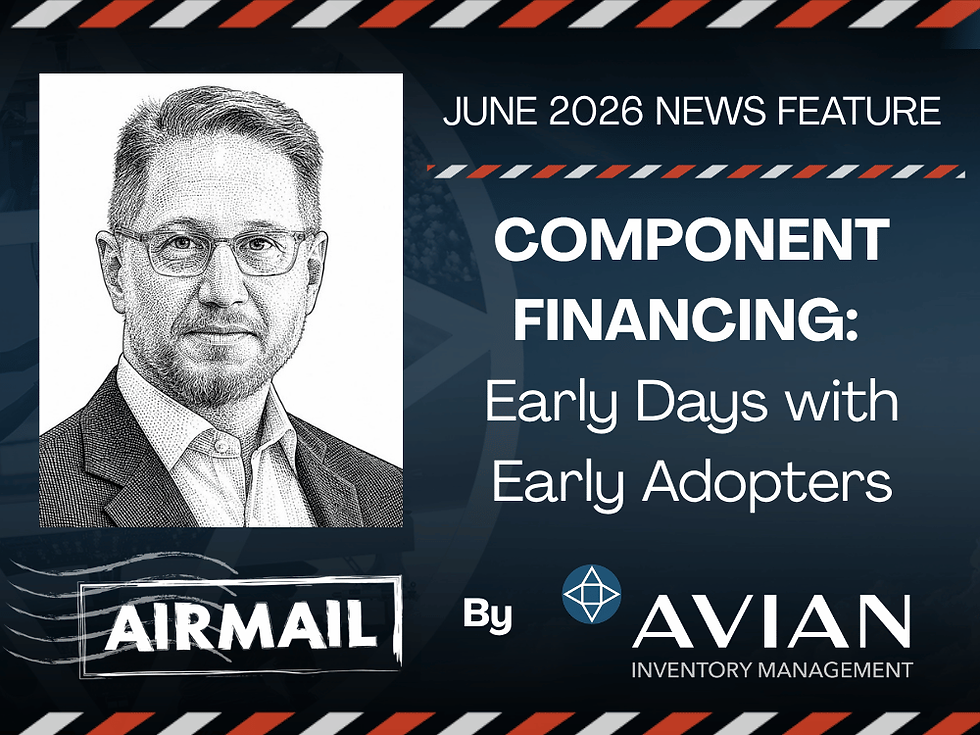
AVIAN Insights … with Doug Ingraham, VP Business Development
Frothy Appetites with Limited Supplies, is Leveling in Sight?

Reflecting upon the recent Ishka Aviation Investival: North America and Airline Economics Growth Frontiers Americas conferences, both in New York, it’s clear our business is still defined by strong investor appetite on one side and continuing operational bottlenecks on the other. The conversations in those rooms and other meetings lately, whether with OEMs, Investors, Lessors, or MROs all circled back to a main theme: supply-chain constraints. That, and the shifting opinions on how long it will persist, remains the driver steering asset values, availability, and underwriting logic.
The market for used serviceable material (USM) and end-of-life assets continues to be underpinned by those same forces. “New” engine technologies (LEAP and GTF have now been flying pax for 10 years now), while delivering better efficiency, are still delivering less time-on-wing than expected and, at best, neutral to slight benefit total economics to operators.
The ongoing delayed deliveries of new aircraft/engines, a constrained global MRO ecosystem, and insufficient engine shop capacity as both materials and labor availability continue to lag post-pandemic recovery results in a supply chain stretched to its limit. Fewer engines can get through the shops, and that ripple effect drives demand and prices throughout the secondary market, including older airframes/engines.
Underlying these operational challenges are macroeconomic pressures that are changing the math for teardown and parts investors around component repair. Inflation “catch-up” has pushed component MRO pricing sharply upward, and now we’re seeing tariffs re-emerge as a potential factor, or at least an excuse, for fees and price increases. The rule of thumb for cost of component repair was once 20% of FMV but now we and our colleagues are seeing 25-35% averages. This is especially evident where supply is tight and MRO capacity is limited.
Further, despite some deals and exceptions being implemented, the U.S. aerospace sector is still facing some import duty and trade-policy uncertainty: dependencies on global sourcing of materials and parts mean that tariffs could raise future costs, lengthen lead times and in some cases shrink margins either for investors and/or industry players. All of this is forcing operators, MROs and OEMs to re-evaluate repair economics, supply-chain sourcing, and component teardown strategies.
Despite these challenges, capital remains readily available as we see increased allocations to the sector and risk-on appetite, from thin-spread capital market financing for new metal/lessors to private money seeking yield in EOL and USM. While deal activity continues at a steady pace, from M&A to asset-level investments, the combination of increasing capital allocation to the sector, combined with more stringent underwriting due to forecast uncertainties, is leading to “dry powder” growth since the beginning of the year.
We have heard, in recent conversations, that sentiment among colleagues is starting to shift, with some saying we may be at top valuations for aircraft and engines. Driven by OEMs and MRO increasing capacity as well as engines with supposed reliability improvements slowly taking up more wings. However, the combination of extended turnaround times for shop visits, limited green-time availability, and strong utilization is sustaining appetite for mid-life and mature assets, as well as the parts to support them.
Specifically, there is a growing sense among participants that the EOL airframe segment may have reached a peak. Teardowns have been robust, but values for certain airframes appear to be plateauing. The market is watching closely to see how the supply side evolves as new-technology deliveries ramp up and as OEMs, particularly Pratt & Whitney, begin to resolve durability issues such as the powdered-metal challenges in GTF engines.
If those engineering fixes succeed in extending time on wing for both GTF and LEAP families, the pendulum could begin to swing back toward new-technology economics. A potential retirement/ teardown ”bow wave” could quickly change the Parts/USM market but we at AVIAN believe the shift will be slower and less pronounced given the very substantial multi-year backlog for most new aircraft variants and the covid-stress-tested resiliency of demand appetite for air travel.
The next 12-18 months will reveal whether the current supply squeeze represents a structural recalibration or a temporary plateau. It would not be the first time that the market called a peak too early. What’s certain is that access to capital and access to capability (shop capacity, parts access and material flow, skilled labor geopolitical/trade risk) are now equally strategic. The investors who can combine both sides of that equation, financial muscle, and operational resilience, will be the ones driving returns.
AVIAN provides customized capital solutions to OEMs, Airlines and MROs as well as global aerospace component distribution.
About the AVIAN Inventory Management Orlando, FL Distribution Hub:
93,000 PNs/ 219,000+ line items/more than 14M parts received
Opened in October, 2021; facility designed to spec
AS9120 / ISO 9001 Certified
Meets FAA AC-00-56B requirements
Operates to FAA standards
72,000 sq.ft. Class A facility with a 12,000 sq.ft. climate-controlled storage room
AvSight integrated IMS
Use of on-site Sales Channel Partners (“SCPs”) to speed parts to global customers
About AVIAN Inventory Management
Designed to promote accessibility and speed to market, AVIAN’s focused distribution center in Orlando, Florida delivers unparalleled product availability to all aircraft operators, and maintenance and repair stations around the world, providing a one-stop, same-day, go-to access point through its multiple Sales Channel Partners.